Webb Observes Distant Fast Radio Burst
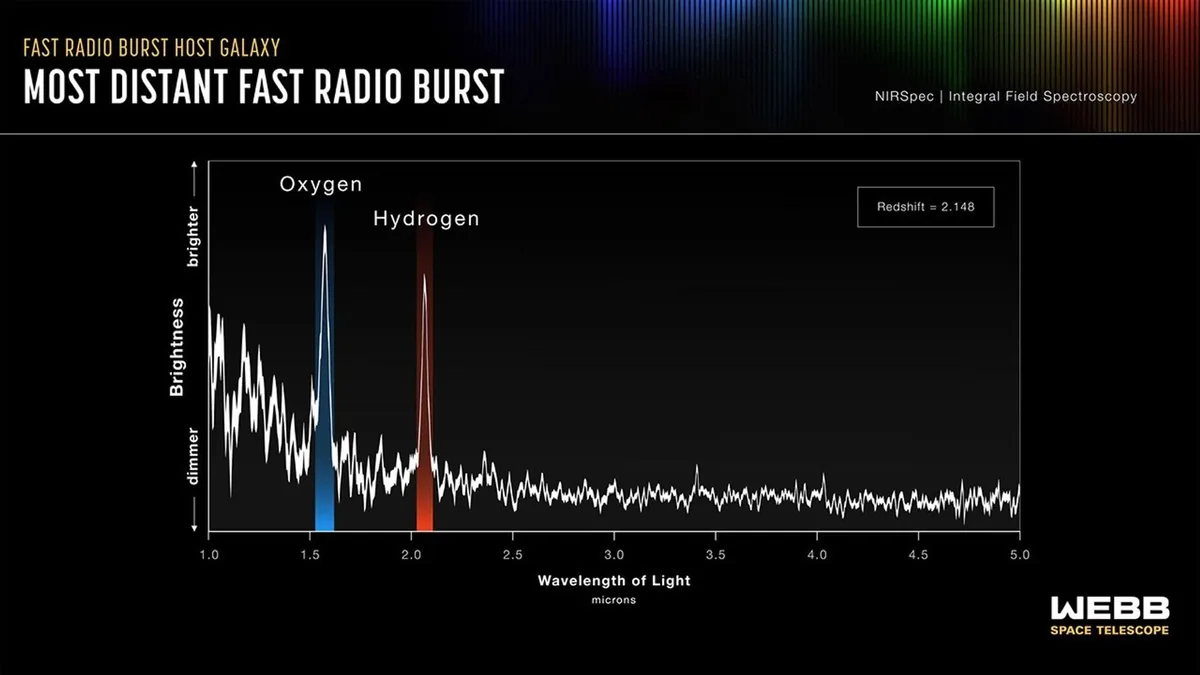
Astronomers used the James Webb Space Telescope to study a fast radio burst over 10 billion light-years away. The observation provides new insights into the nature of these brief, powerful signals.
The burst's origin is linked to a neutron star, offering clues about cosmic sources of high-energy radio waves.
- payload
- Webb
Taken from the source as published — check the details before acting on them.
burst location
the signal originated from a galaxy 10.3 billion light-years away, in the constellation Eridanus.
telescope use
the james webb telescope captured the burst's afterglow, revealing details about its environment and energy output.
neutron star link
the data suggests the burst may have been caused by a neutron star merger or a magnetar flare.
Common questions
how far away was the burst?
it occurred in a galaxy 10.3 billion light-years from earth.
what caused the burst?
the data points to a neutron star merger or a magnetar flare as possible sources.
Sources
- The Most Distant FRB Tells The Story Of Its Origin By https://www.universetoday.com/authors/brian, Universe Today · universetoday.com
Headlines and links belong to the publishers listed above. The summary above is written by The Orbital Brief; see how this works.